
What’s next for search? Dive into five GEO trends shaping how we optimize for AI-driven search engines like ChatGPT, Google Gemini, and more. These trends are not only revolutionizing the way we approach search engine optimization but also affecting how businesses reach and engage with their audiences on a global scale. As the digital landscape continuously evolves, understanding the implications of these changes becomes crucial for marketers and content creators alike. From localization strategies to the increasing importance of voice search and visual content, embracing these shifts will empower us to enhance visibility and drive meaningful interactions with users across diverse geographic regions.
What does this mean for the future of SEO?
If you want your brand to join important discussions, you need to change your approach.
Here are five key trends in GEO that are changing the future of search, along with tips on how to get ready.
1. The evolution of entities
Entities are (once again) changing how we think about search and understanding their evolving role is key to staying visible.
Remember the phrase “things, not strings”?
When Google introduced its Knowledge Graph in 2012, it marked a major shift. They moved from simply matching a “string” of words in text to recognizing distinct “things.” These entities include people, places, products, and ideas.
This shift was the first step towards connecting information in a meaningful web of knowledge. It brings search engines closer to understanding information like a human would.
Now, with the rise of AI-powered search technology, entities have taken on an even greater role. They’re crucial to how AI interprets and prioritizes information.
Entities are connected through knowledge networks
Entities and their relationships are part of knowledge networks, which are organized collections such as Google’s Knowledge Graph, Wikipedia, Wikidata, and other reliable sources.
These networks connect entities and attributes, helping AI understand context, evaluate credibility, and decide relevance.
AI doesn’t just use existing networks; it creates its own connections over time, gaining a better understanding of how things relate in context.
The role of entities in relevance
Entities help AI understand “what something really is.” They identify connections and create a web that links ideas, context, and real-world relevance.
By finding these patterns, it connects related topics, allowing it to provide answers that are clear and easy to understand.
For example, say someone searches:
- “What is a good bike for commuting in San Francisco?”
Instead of treating this as a series of unrelated words, AI interprets it by identifying key entities, attributes and the connections between them:
- Bike: Product (entity).
- San Francisco: Location (entity).
- Beginner-friendly: Experience Level (attribute).
- Commuting: Purpose (attribute).
The paragraph highlights the entities “bike” and “San Francisco” along with attributes like “beginner-friendly” and “commuting” that enhance the query.
AI recognizes that a beginner-friendly bike for San Francisco should handle hills easily. It might have features like an upright design. It could also include easy gear shifting or electric assist.
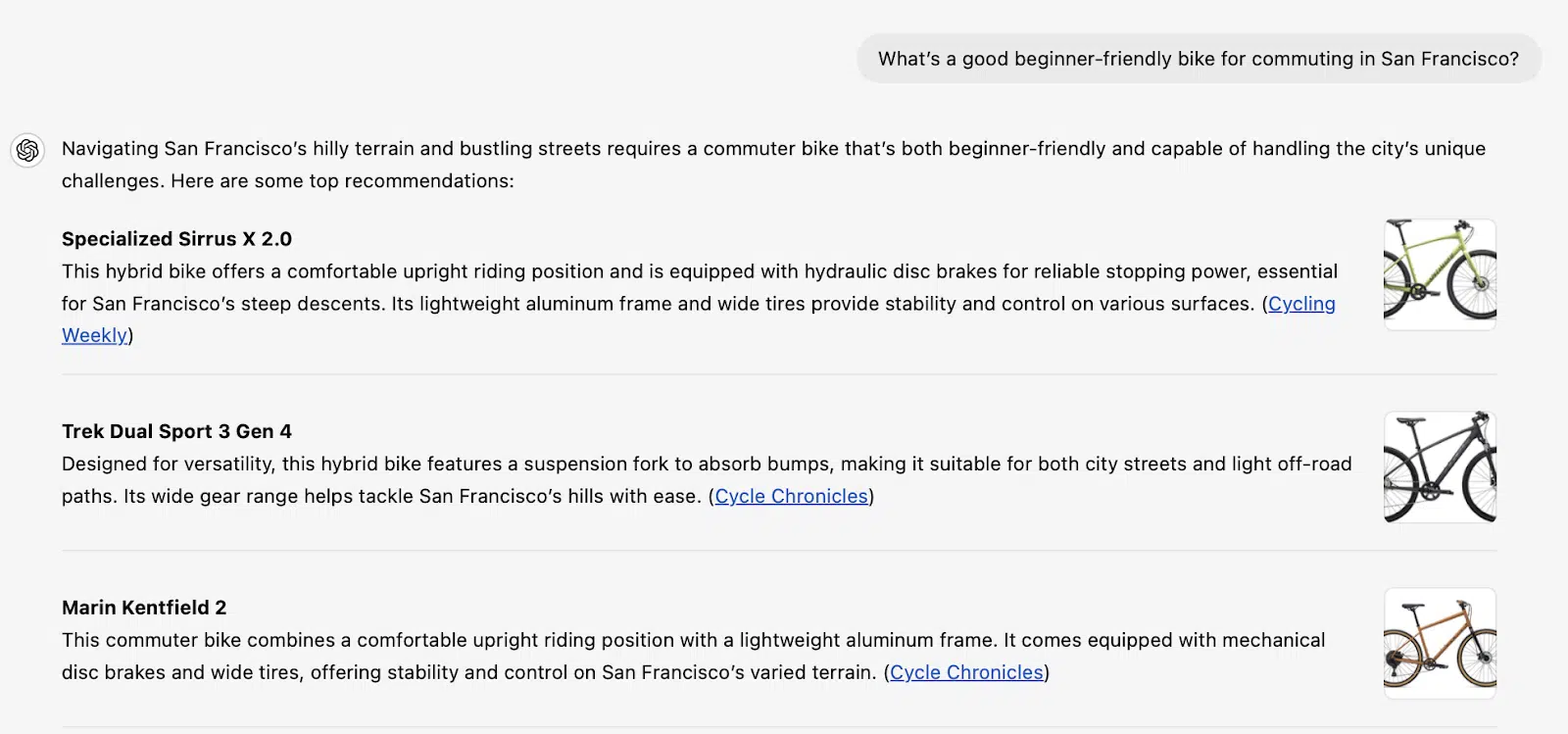
By understanding these connections, AI doesn’t just pull a list of bikes.
It considers the context and intent. It references trusted sources, recent reviews, and customer sentiment. It also includes recommendations to surface options suited to the city’s terrain and the rider’s experience level.
The role of entities in E-E-A-T
However, entities do more than link related information – they establish markers of experience, expertise, authority and trustworthiness (E-E-A-T).
Your brand, too, is an entity in this ecosystem.
Brands are recognized alongside other distinct “things,” and their authority and trustworthiness play a direct role in their visibility.
For topics where accuracy is critical, think YMYL, AI relies on these established connections. It uses them to decide which sources to use.
Brands can establish clear authority in their niche. This involves creating connections with other recognized entities. As a result, they can become the voices AI turns to. This embeds them in conversations around key topics.
2. LLMs and RAG: The tech behind AI-driven search
Entities’ growing importance in modern search is tied to how LLMs and retrieval-augmented generation (RAG) operate.
Understanding this technology helps tie in the “why” behind GEO.
How do LLMs work?
LLMs are trained on extensive datasets. This includes everything from websites and forums to structured databases like Wikipedia and Wikidata. These datasets give them the ability to process and understand the complexities of human language.
- Understanding natural language and intent: LLMs learn how words, phrases, and ideas interact within different contexts. This ability enables them to interpret the literal meaning of queries. They also understand the deeper meaning behind queries. This allows them to generate intuitive, human-like responses.
- Mapping entity relationships: Through entity recognition, LLMs learn to map connections between things. For example, “San Francisco” is recognized as a location linked to attributes like “hilly terrain” or “tech hubs.” These patterns help LLMs synthesize cohesive responses from a web of interrelated knowledge.
- Generating contextually relevant answers: When processing a query, LLMs rely on their pre-trained knowledge. They generate responses that consider both the explicit query and its broader context. This aligns answers with the user’s intent.
Despite their strengths, LLMs face a critical limitation: their reliance on static, pre-trained knowledge.
They can create outdated answers or “hallucination,” which are responses that seem plausible but lack factual accuracy.
RAG powering real-time updates
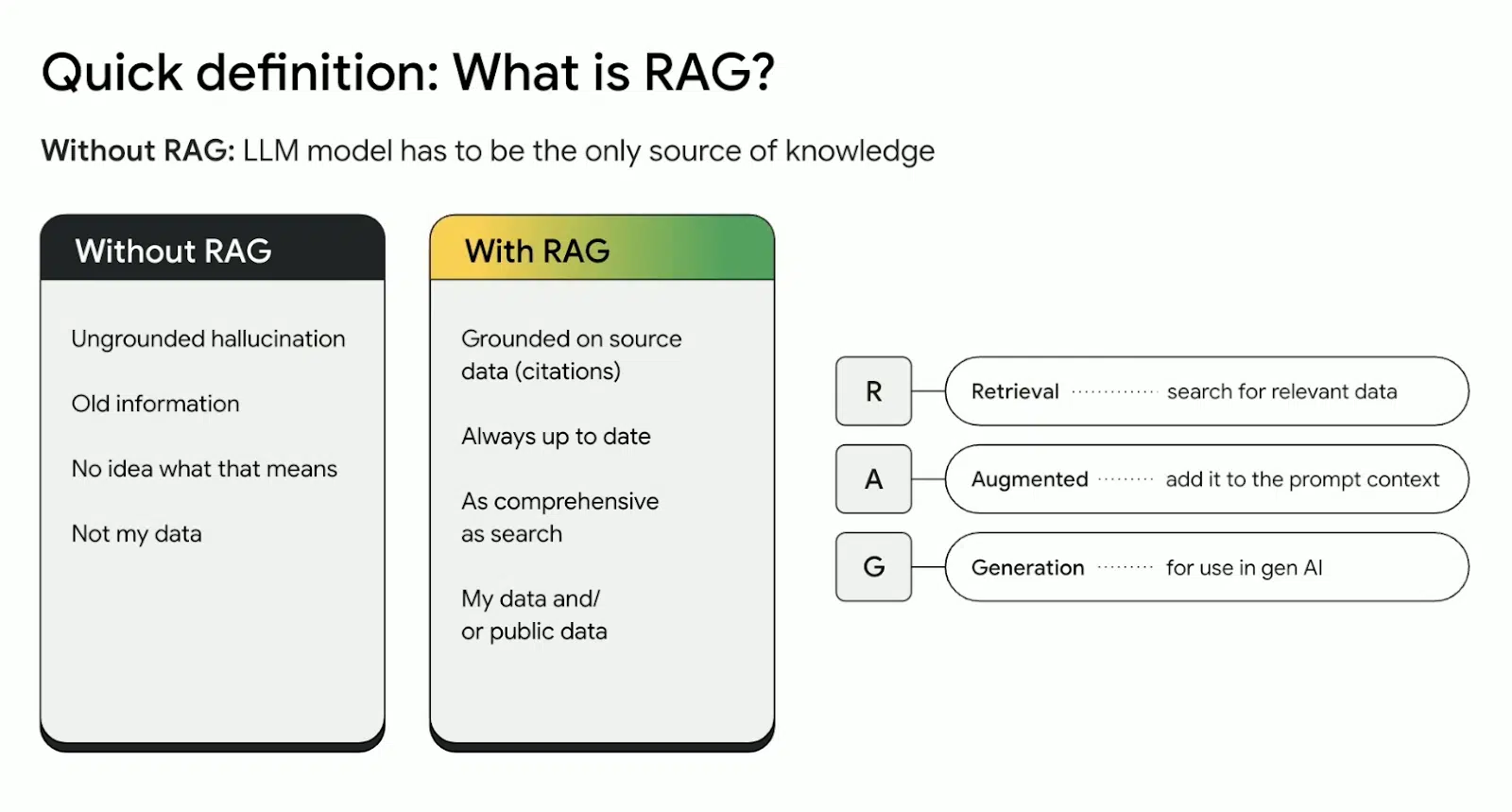
RAG solves these challenges by giving AI real-time access to fresh information.
It does not rely solely on pre-trained data. It retrieves relevant content as queries occur. This method weaves the content together with the LLM’s existing knowledge. This ensures responses stay accurate, timely and grounded in real-world data.
How does RAG work?
According to Google, retrieval-augmented generation enhances traditional LLM workflows by combining three key processes: retrieval, augmentation and generation.
- Retrieval: RAG enhances responses by querying pre-indexed, vectorized data from diverse sources. These include news articles, APIs, Wikipedia, Wikidata, and UGC platforms like Reddit and Quora. Leveraging semantic search, it combines authoritative knowledge with current and emerging trends for a well-rounded understanding.
- Augmentation: Retrieved information is seamlessly integrated with the LLM’s pre-trained knowledge, enriching the prompt context.
- Generation: With this enhanced context, AI generates a response that is precise and grounded in current reality. It combines foundational insights with up-to-date information.
Why this matters for GEO
LLMs build the foundation by understanding context, while RAG ensures what’s delivered is timely and accurate.
For brands, it’s no longer enough to publish content and hope for relevance.
Your content needs to be structured to integrate seamlessly into the databases and knowledge networks on which AI depends. Equally important is building credibility through associations with trusted sources, earning authoritative mentions and fostering real-time engagement.
The goal is to become the go-to source of information AI consistently turns to.
How do you get there? It starts with entity optimization.
3. Embracing the New Age of Entity Optimization
Entities are how AI makes sense of the world. But knowing their significance is just the beginning.
For your brand to thrive in the interconnected web of AI understanding, it needs to become a part of the story. Here’s how to get started.
Implement schema markup
Structured data ensures AI can interpret your content and how it connects to the larger web of knowledge.
- Define key entities: Use schema markup to define your essential entities – people, places, products and concepts.
- Connect to trusted sources: Use sameAs schema to link your brand to authoritative profiles. Examples are Wikipedia, LinkedIn, and other trusted sources.
- Link verified profiles: Tie your brand’s social media and professional profiles together for a consistent and credible digital presence.
- Use mentions schema: Highlight notable entities within your content and use mentions schema to signal engagement in the broader ecosystem.
Build connections in key knowledge networks
Embedding your brand in knowledge networks, graphs and other structured databases lays the foundation for AI recognition and trust.
- Claim and manage knowledge panels: Regularly update your Google Business Profile and other knowledge panels with accurate, up-to-date information.
- Create and maintain Wikidata entries: Anchor your brand in the Wikidata knowledge graph by consistently providing comprehensive and reliable information.
- Aim for a Wikipedia page: While creating a Wikipedia page boosts credibility, not every brand qualifies under its strict guidelines. If it’s not an option, focus on securing mentions in authoritative sources – these can be just as impactful.
Secure brand mentions in reputable sources
Earning brand mentions and links from trusted sources builds credibility. This positions your brand to be a voice AI references in key conversations.
- Create shareable, valuable content: Publish insights or resources that naturally encourage others to cite or reference your brand.
- Collaborate with thought leaders: Partner with industry experts on articles, interviews or webinars to strengthen your credibility.
- Appear in respected publications: Proactively secure placements in well-regarded industry outlets to solidify your reputation.
- Use targeted digital PR: Focus campaigns on earning mentions in authoritative sources frequently cited by AI or well-connected to your brand’s core entities.
Let’s refer back to the example from before.
- “What’s a good beginner-friendly bike for commuting in San Francisco?”
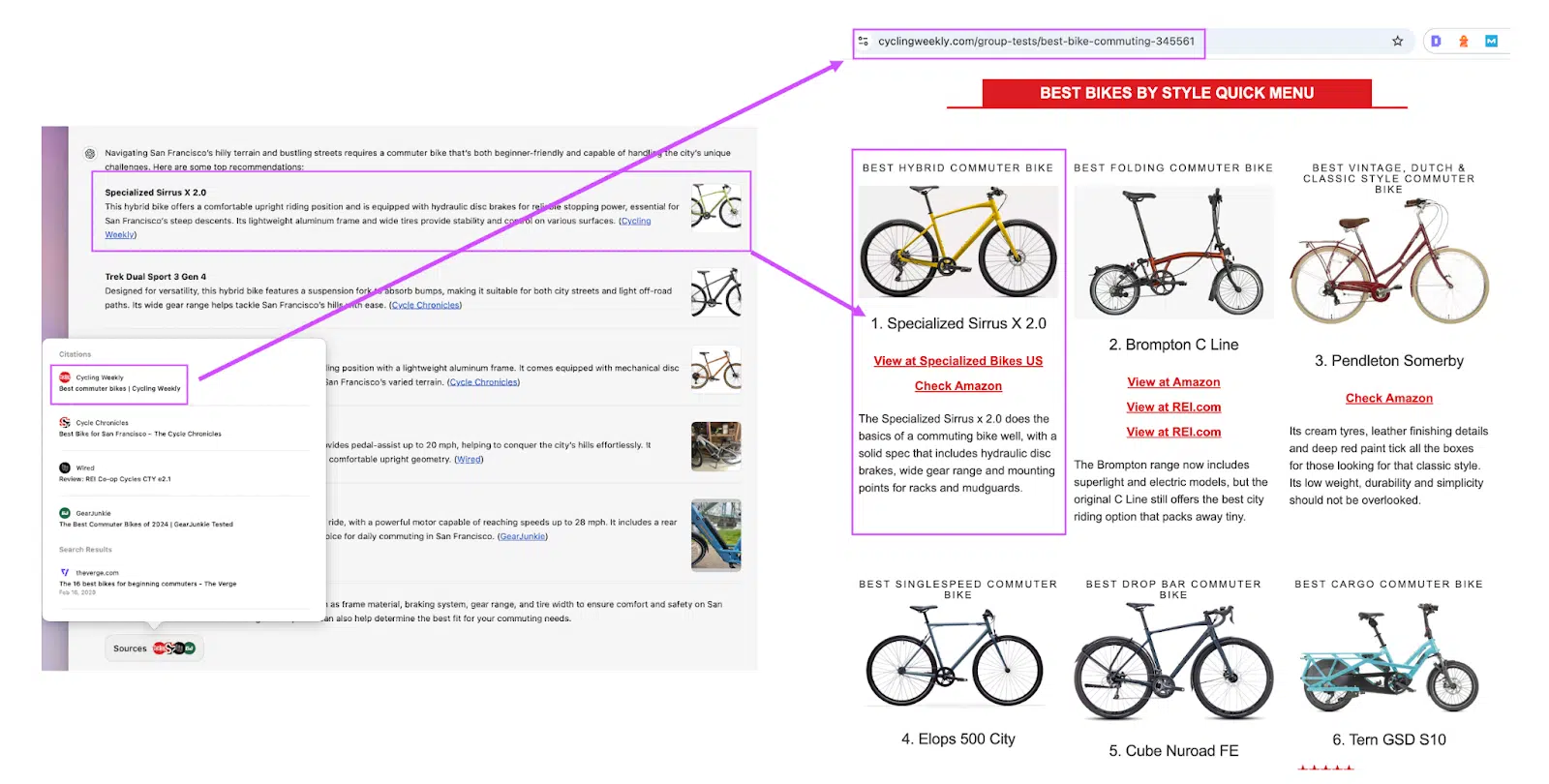
The AI response highlights the Specialized Sirrus X 2.0 as the top pick. Although the AI doesn’t link to the brand’s website, it mentions the brand name directly.
The source cited in the AI response, Cycling Weekly, had ranked the bike first in its Best Commuter Bikes of 2024 article.
This highlights the importance of indirect inclusion: a brand appears in the AI response because it was mentioned in a trusted industry source.
The AI cited this reputable publication and the brand was part of the conversation – even without a direct link.
Use real-time and dynamic content
AI’s ability to surface relevant insights depends on a constant influx of fresh information.
Platforms like Reddit, Quora and Stack Exchange offer a front-row seat to the questions people are asking. They also show the challenges they’re navigating. They’re also prioritized by AI for their unbiased and authentic experiences.
Participating in active conversations and fostering engagement will keep your brand part of the narrative shaping your industry.
- Keep content current: Regularly refresh blog posts, news articles and product pages to reflect the latest trends and updates.
- Engage with forums and UGC: Monitor and engage in discussions in your niche and identify shifts in language or topics. These platforms can uncover perspectives that reshape how you approach key themes.
- Create content with impact: Publish research, insights, or thought leadership. Ensure it addresses pressing questions. Also focus on emerging trends that matter to your audience.
Align content and links with entities
Your content and internal links should tie your brand to relevant entities. This makes it easier for AI to identify and understand those associations.
Tools like TextRazor can help uncover key entity relationships to refine your approach.
- Mention known entities: Include significant people, places, products and concepts to strengthen your brand’s relevance to topics in your niche.
- Link to verified sources: Reinforce your credibility by linking to well-established, trusted entities.
- Use internal linking: Build connections between related content. Use an ontology-based approach with a clear, hierarchical structure. This will showcase your expertise.
- Develop content clusters: Organize content into clusters to signal depth in your experience. This strategy focuses on comprehensive coverage of your key topics.
- Focus on E-E-A-T: Build credibility through experience, expertise, authoritativeness and trustworthiness to create a strong digital footprint. Focus on author credentials, citations and high-quality backlinks.
4. The rise of multimodal search
Users are now accessing information using voice commands, videos, images, and audio in ways that seemed impossible a few years ago.
Platforms are evolving quickly to meet this demand.
Google Lens now processes a staggering 20 billion visual searches per month, proof of the growing appetite for interactive search experiences.
Using RAG, AI can retrieve multimodal embeddings and process them alongside text to create richer and more complete responses.
But what makes these experiences feel cohesive? Entities.
They’re the framework that transforms scattered pieces of content into something meaningful – an interconnected narrative.
For brands, this means stepping back from viewing media assets as standalone efforts. Instead, success depends on ensuring that all content formats are part of a unified strategy.
How to optimize and connect your media assets
- Images: Use alt text and metadata rich with relevant entities and
ImageObjectschema. - Voice search: Structure FAQ-style content with
FAQandQ&Aschema. - Video content: Add transcripts, captions and
VideoObjectschema. - Audio content: Add transcripts and
AudioObjectschema.
Example: A fitness brand optimizing for the topic “core strength workouts”
- Blog post with images: Write an article about core exercises, tips and benefits. Include images with alt text like “plank position for core strength” and apply
ImageObjectschema. - Voice search: Add an FAQ section answering questions like “What are the best core exercises?” with
FAQschema. - Video content: Create and embed an instructional video demonstrating exercises step-by-step, sharing it across social media. Include a transcript, captions and
VideoObjectschema. - Podcast episode: Release an episode on core strength tips using
AudioObjectschema and linking a transcript to the blog post. - Entity linking: Reference the video series and podcast within the blog post. Cross-link the blog, video and podcast to reinforce connections.
- Structured data: Apply
sameAsproperties to connect related content and strengthen entity relationships.
This alignment creates an informative, immersive experience ready to engage users no matter how they choose to search.
5. Personalized, predictive search experiences are here
Now, imagine a search engine that anticipates your needs. It offers suggestions and solutions before you even think to ask.
With generative AI, we’re already there.
Personalized search already tailors results to your preferences. Predictive search goes a step further. It anticipates needs based on your behavior, interests, and engagement across the digital ecosystem.
Let’s say you’re planning a home garden. You start by searching for ” the best vegetables to grow in spring.”
Later, AI comes in with personalized suggestions: planting schedules, frost alerts and nearby nurseries just as you’re ready to shop.
As your project unfolds, it adapts. It offers seasonal care tips and connects you with gardening communities. It presents information in the format you prefer to consume at each stage of your journey.
This layer elevates traditional personalization, moving these experiences from “helpful” to “indispensable.”
Why this matters for GEO
Predictive search runs on dynamic entity profiles. These profiles are real-time representations of brands, people, products, and concepts. They continuously adapt to new data.
AI enriches these profiles with fresh insights pulled dynamically from knowledge networks, making them accurate as things change.
For brands, staying part of this evolving ecosystem requires content that remains agile. The content must also be timely and responsive to shifting user preferences and expectations.
In other words: listen to your audience – even when they don’t quite know what they’re looking for yet.
How brands can stay ahead
- Map content across the user journey: Anticipate user needs at each stage of their journey. Build interconnected content that moves seamlessly between related topics and formats.
- Adapt with real-time insights: Use trends, emerging data, and feedback from your audience. Keep your content current and reflective of what they care about right now.
- Redefine value in predictive experiences: Think beyond immediate queries. Offer tools, guides, and insights that your audience will find useful, even when they’re not actively searching for them. Consider implementing a variety of formats. These include interactive tutorials, comprehensive resource databases, and personalized content suggestions. This approach can proactively engage users and enhance their overall experience with your platform. Keep their needs and interests at the forefront of your strategy.
Meeting users where they are and where they’ll be next builds trust, authority and lasting loyalty.
Embrace Adaptability
The future is diverse, tailored to individuals, and driven by connections.
Each trend shows that search has changed to create meaningful, connected experiences.
Search is growing, and you need to keep up.
To stay ahead, be flexible in your GEO strategies and understand the technologies driving change.
