
AI isn’t replacing marketers; it’s changing how we work. Learn about the future and why many organizations aren’t prepared.
Prediction 1: AI Adoption Will Remain Slower Than Expected
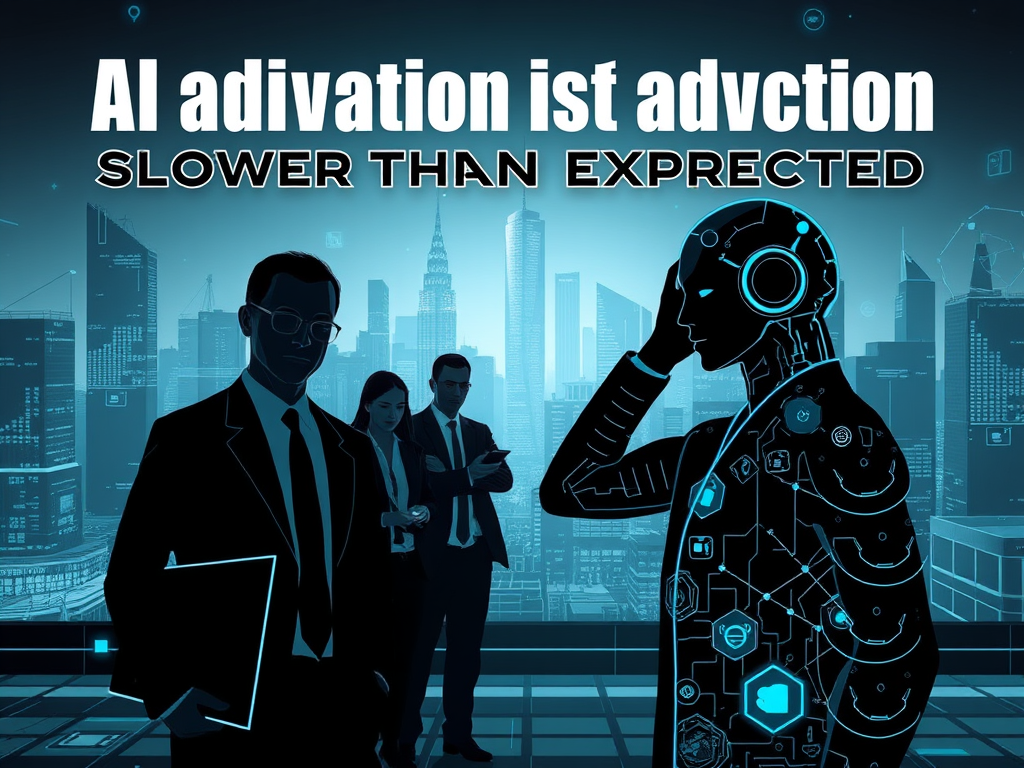
So why do I say that enterprise AI adoption remains slow and will continue to be?
The process of integrating artificial intelligence into existing business frameworks is fraught with challenges. These include a lack of understanding about its capabilities. Concerns over data privacy and security arise. There is also a need for significant investment in infrastructure and training. Many organizations fear that AI disruption outweigh its benefits. This fear leads to hesitance in pursuing these transformative technologies. Additionally, the rapid pace of AI development creates uncertainty. This uncertainty makes it difficult for enterprises to commit to long-term strategies. These strategies would incorporate these innovations. As a result, decision-makers often take a cautious approach. They prefer to observe how AI evolves in other industries first. Only then do they fully commit their resources. This hesitation ultimately contributes to a slower adoption rate across the enterprise sector.
According to HFS Research, only 8% of enterprises have achieved organization-wide adoption of AI. And McKinsey’s latest survey tells a similar story: fewer than 20% of companies report any measurable revenue increase from AI. On the cost side, just 23% have seen savings only 6% of those exceeding 10%. In fact, 39% report AI has actually increased their costs. This underscores that most organizations are still in the investment and experimentation phase.
AI holds immense promise, but adoption is uneven. The gap between the AI “haves” and “have-nots” is widening. It’s only going to grow as business sectors try to catch up with the latest technical trends.
Prediction 2: Data, Bias, and Accuracy Fears Are Here to Stay—Brace Yourself!

Why are companies moving slowly? In my experience, the biggest barriers include a lack of clear vision. This absence often creates strategy issues, leading to uncertainty among teams and decision-makers. Additionally, inadequate communication channels within the organization can stifle collaboration and impede progress. Resistance to change is another significant factor, as many employees may feel uneasy about new processes or technologies. Furthermore, budget constraints can limit the resources available for innovation and development. This makes it challenging for companies to keep pace with the rapidly evolving market landscape. Ultimately, addressing these barriers is crucial. It’s necessary for fostering a more agile and responsive organizational culture. Such a culture can adapt to changing demands and seize new opportunities. Some extra barriers include:
- High cost and long time-to-value for AI applications.
- Security, compliance, and transparency concerns.
- Inconsistent quality or accuracy of AI outputs.
- Shortage of AI-specific skills and resources.
While the last two are improving with fast innovation and more talent, two concerns will remain:
- Data privacy: How is my data used? Am I exposing sensitive information?
- Trust in the output: Could AI create bias or give incorrect advice for my business?
These fears are real, but they are often exaggerated by false information. Large Language Models (LLMs) aren’t dangerous by nature; they are simply advanced systems. Like any system, their effectiveness depends on the quality of the data and management that influence them.
AI isn’t going away. It’s becoming more pervasive by the day. The real question is: how can your organization embrace the technology while managing its risks before you fall behind?
Prediction 3: Marketing Will Transform from Generating Noise to Driving Bold Insights and Actions

Marketing is data-driven, which is why it will keep leading in AI adoption.
AI-powered content generation is only the start. The next step is a new type of marketing tools. These are independent systems that not only create content but also make smart decisions throughout the marketing process.
Here are a few emerging use cases:
Customer journey orchestration
Agents will create personalized experiences instantly, triggering content, ads, and interactions across channels automatically.
Dynamic content generation
Campaigns will be customized widely, with agents adjusting text, images, and actions based on individual behavior and preferences.
Product launch execution
Agents will organize launch plans, manage activities, track progress, and give updates automating many manual tasks.
Ad campaign optimization
AI will manage budgets, test ideas, target audiences, and adapt quickly to achieve campaign goals.
SEO and content strategy
Agents will analyze competitors, find content gaps, and create SEO-friendly content while monitoring results and improving strategy.
Trend monitoring
Regularly checking social, news, and competitor channels will reveal insights, threats, and new opportunities.
Simulation and Scenario Planning
AI personas will test campaigns, messages, and product ideas before launching to lower guesswork and risk.
Virtual Assistants
Agents will understand what buyers want and take actions to increase sales and solve problems.
Autonomous reporting and analysis
AI will compile and analyze data from across systems. It will generate narratives for different audiences. The system can detect anomalies and surface insights in real time.
In a bold new era: Marketing is ditching the tedious task of execution. It is stepping into the thrilling role of directing. Marketing is handing over the reins to agents. Meanwhile, human minds strategize like never before.
Prediction 4: AI Will Transform Work – Embrace or Be Left Behind!

There’s a lot of speculation about AI eliminating jobs but I believe it’s more about transformation than replacement. As technology continues to advance, we encounter a crossroads. The integration of AI in various sectors is prompting a shift in how we approach work. AI is enhancing our capabilities. It is creating new opportunities that require different skill sets instead of simply rendering certain jobs obsolete. This transformation encourages workers to adapt. They need to retrain and embrace the innovations that AI provides. This ultimately leads to a more efficient and productive workforce. We should view AI as a tool that complements human effort. This perspective lets us begin to harness its potential to drive growth. It also helps us foster creativity in ways we have yet to fully realize.
McKinsey’s research supports this view:
- Only 31% of organizations believe AI will reduce headcount.
- 38% expect no change.
- 19% predict growth in roles where AI is deployed.
- In high-AI-adoption areas, like Marketing, the outlook is even more positive.
AI will take care of routine tasks. This allows people to focus on important work like planning. They can find insights and solve problems creatively. Reporting will shift from just collecting data to making sense of it. Customer service representatives will manage fewer simple questions and have more time for important conversations.
The future of work will not be less human; it will be more human, supported by AI.
Prediction 5: Brace Yourself for the “Trough of Disillusionment”!
If the last section was optimistic, here’s a dose of realism.
We’re nearing the “trough of disillusionment” in Gartner’s hype cycle. Expectations for AI are sky-high and that sets the stage for inevitable disappointment. Here’s why:
- Firstly, the gap between what AI can now achieve and what many expect it to do is significant. Organizations are investing heavily in AI with hopes of miraculous results in a very short timeline. But, the technology is still maturing, and real-world applications often reveal limitations that were not initially obvious. Many projects face obstacles, including data quality issues. They also face integration challenges. Additionally, there is often a lack of clear understanding of the technology’s capabilities among stakeholders.
- Secondly, the over-promising of AI’s potential can lead to disillusionment both within organizations and among consumers. When the anticipated results do not materialize, trust in the technology can erode. This skepticism can create resistance to adopting AI solutions in the future. Fears of under-performance and over-hype overshadow the genuine advancements being made.
Moreover, economic factors can contribute to this state of disillusionment. As budgets tighten and funding for innovative projects wanes, companies find themselves reevaluating their AI initiatives. The pressure to deliver results quickly can lead to hasty implementations that fail to deliver long-term value, further fueling disappointment.
In conclusion, while the potential for AI remains immense, we should approach it with a healthy dose of realism. Acknowledging the challenges and managing expectations can help pave the way for more meaningful advancements in the technology. This ensures that when we emerge from this trough, we do so with a more grounded perspective. It also provides a clearer pathway ahead.
Despite the challenges, my optimism burns brighter than ever! Here’s why:
- Not all AI solutions are the same; some are over-hyped and do not deliver, leaving buyers disappointed.
- Fragmentation is common. Teams use tools separately, leading to silos, governance issues, and integration costs.
- Regulation will create complications. Regional mandates will increase compliance challenges.
- Output quality is often inconsistent. While AI is easy to use, achieving good results can be challenging, causing many projects to stall in pilot phases.
This signifies that AI is on an upward trajectory. We are simply navigating through essential growing pains.
Prediction 6: The Unstoppable Rise of AI in Marketing!
Despite the challenges, I’m incredibly optimistic! Here’s why:
- AI will become a normal part of business, like cloud computing or CRM.
- Organizations will improve governance, architecture, and risk management.
- Specialized models will be created for different industries and jobs.
- Costs will decrease and performance will improve.
- Open standards and frameworks simplify processes and speed up adoption.
Most importantly, businesses will start to see real value in several impactful ways. Companies will adapt and innovate. This effort will result in significant revenue growth. Organizations that embrace new technologies can tap into previously inaccessible markets. They can also enhance their offerings and ultimately increase sales and profitability.
Cost efficiency will also play a crucial role in driving success. As enterprises improve their processes and streamline operations, they will reduce unnecessary expenditures and assign resources more effectively. This efficiency will not only bolster the bottom line but will also allow businesses to invest in future growth opportunities.
Moreover, employees will find themselves engaged in more meaningful work. As automation takes over repetitive tasks, team members will be empowered to focus on higher-level creative and strategic projects. This shift not only boosts job satisfaction but also enhances productivity and innovation within the organization.
Lastly, better customer experiences will result from this transformation. Companies will use data to understand their customers’ needs. They will also seek insights into customer preferences. This will allow them to deliver personalized and prompt solutions. These solutions will resonate deeply. This commitment to customer-centricity will foster loyalty and drive long-term business relationships.
Marketing teams and enterprises as a whole will look back on this moment not as the peak. They will see it as the beginning of a new era in business. By cultivating a culture of continuous improvement, they will position themselves for success. They will also embrace adaptability for growth in an ever-evolving landscape. The opportunities ahead are vast, and the journey has just begun.
