Unleash the Power. Discover how SEO and GEO strategies clash. Learn why merging them is your secret weapon for dominance in search and AI!
Search is changing quickly. AI tools now provide direct answers, while traditional search engines show links.
To stay visible, marketers need both search engine optimization (SEO) and generative engine optimization (GEO).
This article explains both methods. It points out their differences. Then it shows how they work together to help you reach more people.
What is SEO?
SEO helps a website appear higher on search engine results by making its content fit what search engines look for.
It focuses on using relevant keywords in a natural way. It gets links from reliable sites. It also ensures the site works well. This includes loading quickly and being easy to use on mobile devices.
In the past, success was measured by various metrics. These included how many people clicked on your site. They also included where your keywords ranked and how long visitors stayed on your page. All of these showed how well your site met what users were looking for.
What is GEO?

GEO focuses on preparing content for AI-driven platforms that synthesize answers rather than list links.
It aims to make the material easy for AI to parse and cite. This is done by using structured headings, clear statements of fact, and authoritative references.
GEO success is measured by how frequently your content is cited in AI-generated responses, reflecting your visibility in conversational search.
| Aspect | SEO | GEO |
| Target | Traditional search engines, such as Google and Bing. | AI platforms like: – ChatGPT – Google Gemini – Google AI Overviews/AI Mode – Perplexity |
| Focus | Keywords, backlinks, site performance | Content structure, factual clarity, citation potential |
| Success Metrics | Higher traffic, click through rates, engagement | AI citations, response inclusion, share of voice |
| User Action | Click-through to website | Read answers with source references |
| Optimization Approach | Manual research, technical SEO | AI driven analysis, entity optimization |
SEO focuses on getting higher rankings on traditional search engines by using keywords, backlinks, and improving site speed.
On the other hand, GEO is aimed at AI platforms. It works to organize content well and keep facts clear. It also allows for proper citations.
When SEO is successful, it leads to more visitors and better interactions on your site. GEO success is demonstrated by citations in AI. It is also evident when your content is part of generative answers. Users see your content in chat-style formats.
Although they focus on different platforms, SEO and GEO both follow similar basic rules that help create high-quality content.
Are SEO and GEO More Alike Than You Think?
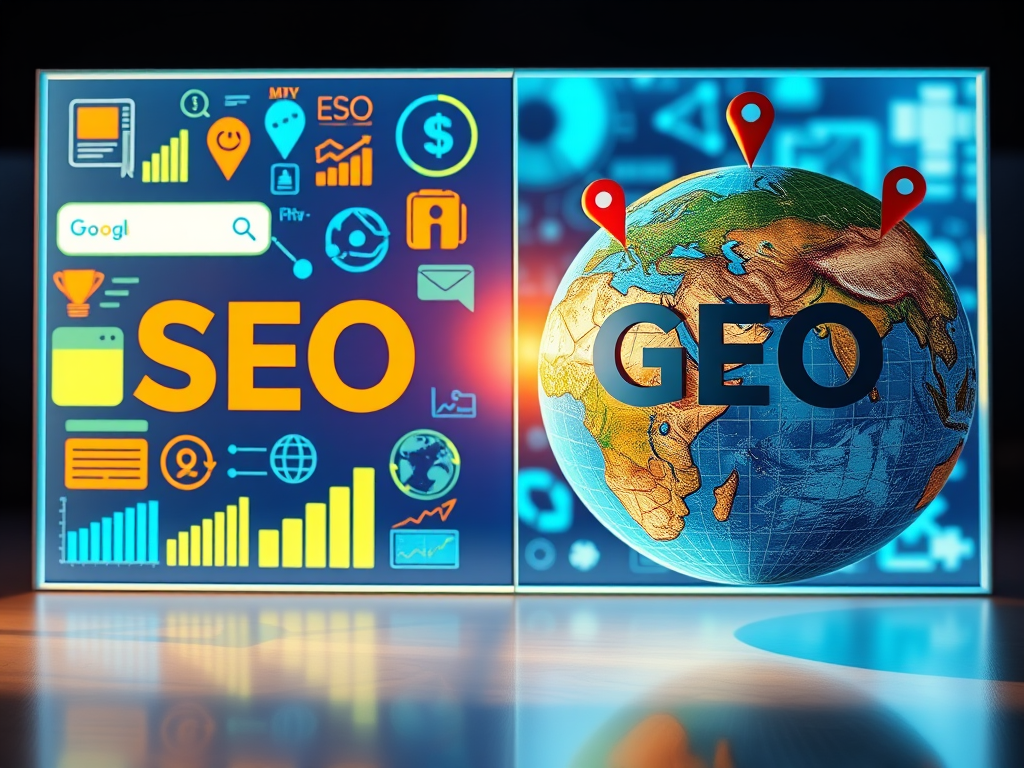
SEO and GEO share a common goal of delivering content that truly meets user needs.
Both approaches start with understanding the questions your audience is asking and crafting answers that satisfy those queries.
Shared goal: Satisfy user intent
By focusing on user intent, you ensure two outcomes. Someone might land on your page from a search result. They could also encounter your content in an AI-generated response. In either case, they find the information they came for.
Content quality is non-negotiable
Both search algorithms and AI models favor accurate, well-researched, and up-to-date material.
Investing time in fact-checking, citing reputable sources, and maintaining clarity can boost your rankings on traditional search engines. It also increases the chances that AI systems will cite your work.
Content quality builds credibility with human readers and with the AI algorithms that parse your pages.
Structure supports visibility
Clear headings and subheadings are essential. They help search crawlers evaluate relevance and context. These elements also guide AI engines to extract key facts accurately.
Well-organized content is easier for people to scan and for machines to parse.
Both SEO and GEO best practices emphasis concise paragraphs, occasional bullet points for lists, and summary boxes where appropriate.
Ongoing optimization matters
Regular monitoring and refinement underpin both approaches. Search algorithms evolve and AI models continually retrain on fresh data.
Reviewing performance metrics – like click-through rates, search rankings, or AI citation frequency – helps identify when to:
- Update content.
- Add new insights.
- Restructure sections.
This ongoing cycle of analysis and refinement keeps your content competitive across both traditional search engines and AI-driven platforms.
User experience is the ultimate test
User experience underpins all of this work.
A person may click a link to your site. Alternatively, they might read an AI-generated summary that includes your content. The ultimate measure of success is how effectively you deliver value.
By prioritizing clear communication, accuracy, and ease of use, you satisfy audiences. You also signal trustworthiness to both search engines and generative platforms.
Rather than choosing one over the other, the most effective strategy blends both approaches.
Unleashing the Power of SEO and GEO Together

To combine SEO and GEO, start by reviewing your best-performing content and enhancing it with:
- Clear subheadings.
- Concise data points.
- Expert quotes.
This satisfies AI extraction needs without harming your SEO foundation.
Broaden your research to include full questions and conversational phrases that both people and AI might use.
Finally, apply structured data markup to provide context that benefits all discovery methods.
Celebrating Our Collective Triumphs
Track SEO performance through your analytics, monitoring rankings, traffic, and engagement.
For GEO, track the frequency of AI mentions and the share of voice in generated responses through your measurement dashboards.
By comparing trends such as changes in click-through rates, you can observe shifts in AI citation volume. This lets you see how adjustments affect both traditional visibility and AI-driven visibility.
Empowering Insights for Practical Action
Unlike traditional search results, GEO outcomes are generated dynamically and can vary based on user context, prompting, and platform behavior.
Aim to create the right ecosystem and variables to increase your chances of being surfaced more frequently and accurately.
Start with clear headings
Use extractable headings that guide both readers and AI through your main points.
Ensure each section has a descriptive title that accurately reflects its content.
This simple step helps AI models pinpoint relevant facts and makes it easier for human visitors to scan your page.
Incorporate compelling data points
Include at least one data point or statistic in each key section. This boosts credibility. It also gives AI answers concrete figures to cite.
These numbers demonstrate authority. Whether it is a percentage, a case study result, or a short survey finding, they enrich your narrative.
Weave these figures into your text so they feel natural rather than tacked on.
Use authoritative references
Add references such as quotes from industry experts or links to reputable studies to reinforce trust.
Concise paragraphs that introduce the insight, give context, and explain why it matters will serve both readers and AI well.
Apply GEO-focused tweaks
Convert dense paragraphs into numbered steps or short sentences that focus on distinct facts.
Add a brief “Key takeaways” box at the end of each significant section. This will reinforce your main message. It will also create a natural extraction point.
Conduct regular content audits
Every quarter, review your top-performing pages to:
- Refresh figures.
- Update expert quotes.
- Refine headings.
As search algorithms evolve, AI models learn from fresh data. These audits ensure your content remains accurate and relevant. They keep it structured for maximum visibility.
SEO vs. GEO
SEO and GEO serve the same purpose of making your content more visible, but operate in different arenas.
SEO, or Search Engine Optimization, primarily drives clicks from traditional search results. It does so through the strategic use of keywords. High-quality content and technical optimization are also important. This process involves understanding search engine algorithms to rank higher in organic search results. Effective SEO strategies can lead to sustained organic traffic, improving your site’s visibility incrementally over time.
On the other hand, GEO, or Generative AI Optimization, secures mentions and visibility inside AI-generated answers. As AI technologies continue to evolve, the way users interact with search engines has shifted dramatically. When users pose queries to AI systems, the responses often draw from a variety of resources. Therefore, making sure your content is represented in these AI-generated outputs is crucial.
By blending both strategies SEO and GEO you create a robust approach that enhances your online presence. Optimizing for ranking signals lets your content stand out in traditional search results. It also prepares it for AI-readiness to be featured in automated answers. This dual strategy ensures that users can find you through both methods. They can choose to click on links or read instant responses generated by AI.
To implement this effectively, start with your best-performing pages. Analyze what content resonates most with your audience and ensure it is well-structured. Add necessary citations to uphold credibility and authority. Track both SEO and GEO metrics. This will allow you to fine-tune your strategies. You can stay ahead in the rapidly evolving search landscape. By continuously monitoring performance, you can adapt to changes in algorithms and user behavior. This approach positions your content for greater success in the digital realm.
