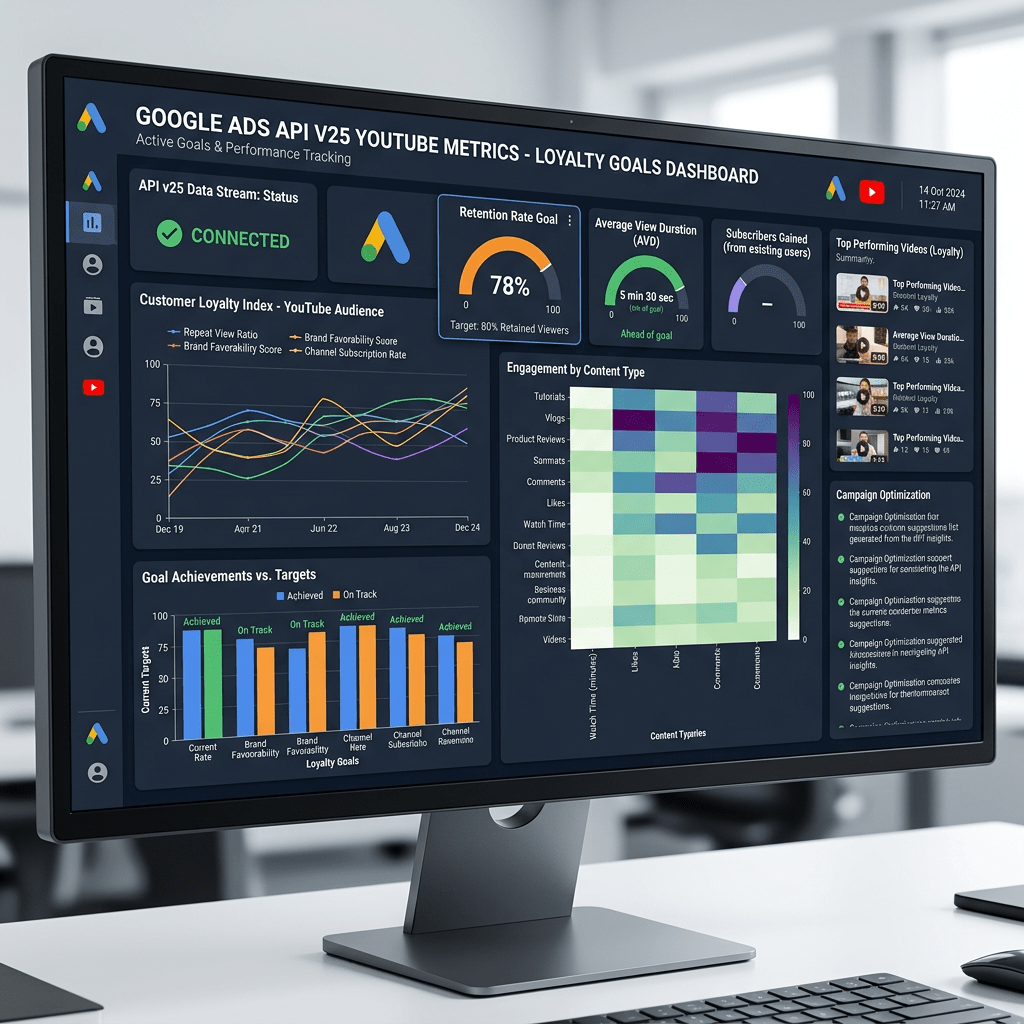
Google Ads API 25 just rewrote the rules: next‑level measurement, ruthless retention, and total control over your objectives.
Google released version 25 of the Google Ads API, adding new reporting capabilities, updated campaign goals, and expanded YouTube measurement tools for developers building on the platform.
The release also introduces changes that require developers to upgrade their client libraries and code to access the new functionality.
What’s new. Google Ads API v25 includes several notable additions for advertisers and developers:
- YouTube ad sub-format reporting: Developers can now break down non-skippable in-stream YouTube ads by duration (standard, up to 30 seconds, and up to 60 seconds) using a new
ad_sub_format_typesegment. This level of granularity matters because advertiser performance varies wildly by duration—shorter ad formats often see better completion rates but lower engagement depth. Previously, developers had to infer this data through workarounds. Now, APIs return native support, meaning third-party tools can automatically segment performance dashboards and optimize bids by duration without custom post-processing logic. - YouTube Shorts engagement metrics: Reports now include comments, likes, and shares for Shorts ads, offering deeper insight into audience engagement. This is a strategic move by Google to position Shorts as a legitimate advertising medium beyond impression and view counts. For advertisers testing creative on short-form video, these metrics unlock A/B testing on social signals—a previously closed data loop. Developers integrating these metrics gain the ability to model which creative elements drive comments and shares, enabling performance-based creative optimization that rivals social media native tools.
- Loyalty retention goal: Advertisers can now optimize campaigns to retain loyalty program members through dedicated campaign and account-level settings, including bid adjustments and member benefits in Product Listing Ads. This represents a fundamental shift in how Google structures advertising goals. Rather than lumping retention into broad audience targeting, loyalty is now a first-class optimization objective alongside acquisition. Developers can set up automated bidding strategies that prioritize repeat purchases from existing members enabling sophisticated cohort-based retention campaigns that adjust bids based on member lifetime value.
- Revamped customer acquisition goals: Google has migrated customer acquisition goals to its unified goals framework, replacing legacy lifecycle goal resources. This consolidation simplifies the API surface for developers but requires updating existing code that references old resource types. The new framework unifies how goals are defined across acquisition, retention, and value optimization—making it easier to manage multi-objective campaigns at scale. However, any integration built on the legacy resources must be refactored to use the new structures, and old resource IDs will no longer resolve.
- YouTube creator insights: Developers can access more detailed creator channel insights, including average views, engagement rates, likes, comments, and audience attributes, for creators who have opted to share non-public data. This opens the door to partnership programs and influencer networks that can now be managed programmatically. Previously, creator data was walled off; now, agencies and brand platforms can build dashboards that pull creator performance and audience composition directly into their reporting systems, enabling data-driven influencer selection and ROI tracking.
The details: API changes and migration requirements
Google Ads API v25 introduces several structural changes that require immediate attention from development teams. The migration from legacy lifecycle goals to the unified goals framework is the most disruptive change—any code that queries or creates LifecycleGoal or LegacyGoal resources will break. Google recommends using the new Goal resource type instead, which consolidates goal types (acquisition, retention, value) under a single schema. The new ad_sub_format_type enum adds three values (STANDARD, UP_TO_30_SECONDS, UP_TO_60_SECONDS) to the existing AdSubFormatType field, meaning client libraries must be updated to support the enum expansion.
On the reporting side, new segments segments.ad_sub_format_type, metrics.youtube_shorts_engagements, and metrics.creator_engagement_rate are now available in the Google Ads Query Language (GAQL). Teams using GAQL to fetch custom reports will need to test these fields in staging environments before rolling them into production queries. The YouTube Shorts engagement metrics (comments, likes, shares) are returned as separate metric fields, so existing aggregation logic that sums all engagement may need adjustment to avoid double-counting or unintended grouping.
Deprecated resources and fields in v25 include the legacy LifecycleGoal resource (use Goal instead), LegacyGoal (consolidated into Goal), and certain customer lifecycle settings that are now accessed through unified account goals. Google’s migration guide recommends testing the new structures in a sandbox account first, then rolling out to production accounts incrementally. Client library versions must be bumped to at least the latest patch release supporting v25; older versions will fail on deserialization of new enum values.
Why you should care. While most advertisers won’t interact directly with the Google Ads API, the updates will benefit agencies, enterprise advertisers, SaaS platforms, and third-party tools that rely on it. New reporting dimensions for YouTube and Shorts provide richer performance insights, while the expanded loyalty and customer acquisition goals enable more sophisticated campaign optimization. Developers should also note that some legacy resources have been removed, making upgrades necessary to maintain compatibility.
Between the lines. Google’s latest API release continues its push toward first-party measurement and lifecycle marketing. The addition of loyalty-focused campaign goals signals a growing emphasis on customer retention alongside acquisition, while expanded YouTube reporting reflects the platform’s increasing importance for advertisers.
The API also aligns more closely with changes already rolling out across the Google Ads interface, ensuring third-party tools can support the latest campaign types and reporting features.
Bottom line. Google Ads API v25 delivers meaningful upgrades for developers and enterprise advertisers, expanding YouTube reporting, modernizing campaign goals, and introducing new retention-focused optimization tools, but upgrading existing integrations is required to take advantage of the new features.
