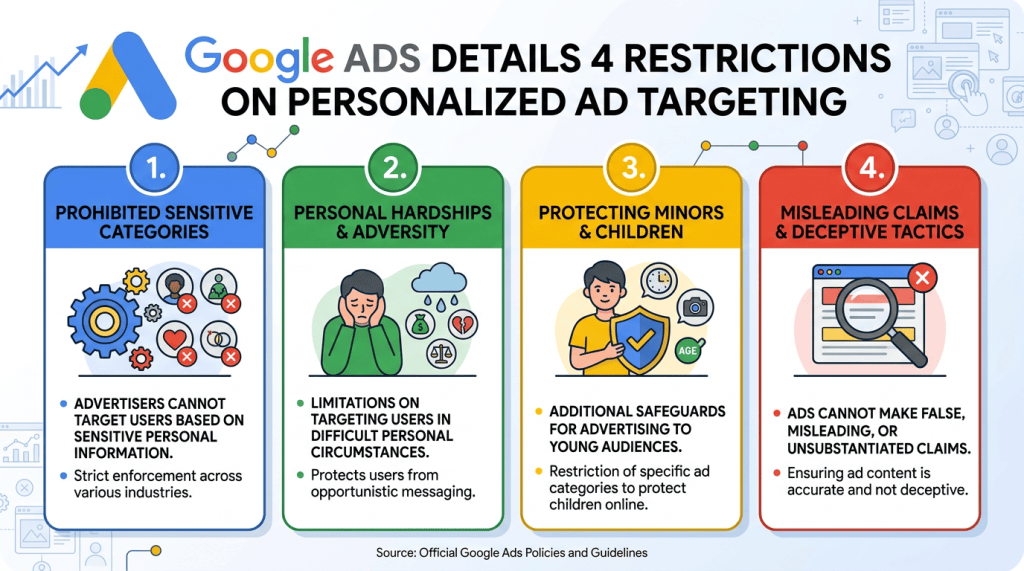
Google has updated its Personalized Advertising Policy to clarify that advertisers may not target users based on their interest in four categories of prohibited content: counterfeit goods, dangerous products or services, dishonest behavior, and inappropriate content.
This change connects Google’s existing prohibited-content rules with its requirements for personalized advertising. In practical terms, a topic that is already restricted in ad content may also be restricted as an audience signal when an advertiser uses interests, custom segments, or similar targeting methods.
What’s changing. Google’s updated policy identifies four existing prohibited-content categories that advertisers must not use as the basis for personalized audience targeting:
- Counterfeit goods: Products that imitate genuine branded goods using identical or nearly identical trademarks or logos.
- Dangerous products or services: Prohibited items such as recreational drugs, weapons, ammunition, explosives, tobacco products, and certain harmful substances.
- Enabling dishonest behavior: Products or services that support misconduct, including hacking tools, fake documents, artificial traffic generation, and academic cheating services.
- Inappropriate content: Content promoting hatred, discrimination, violence, bullying, graphic violence, self-harm, or other material prohibited under Google’s policies.
The important distinction. The update does not mean that every sensitive topic or interest is automatically prohibited. The key issue is whether an audience is being defined specifically around interest in content that falls within one of these four prohibited categories. That distinction matters when reviewing existing targeting settings: advertisers should assess the interests and signals used to build an audience, rather than treating every audience connected to a sensitive subject as disallowed.
- Google already restricts ads that promote this prohibited content.
- The update makes clear that those restrictions also matter when prohibited interests are used for interest-based audience targeting.
Why advertisers need to pay attention. If you use interest-based targeting, custom segments, or audience signals, review how those audiences are defined. A campaign can create risk not only through its ad creative or landing page, but also through the interests selected to identify prospective customers.
Practical examples. An advertiser should not build an audience around interest in counterfeit products, prohibited weapons, hacking services, or content promoting hate and violence. Similarly, a custom audience definition that relies on those interests should be examined and revised rather than assumed to be acceptable because the ad itself uses neutral language. The relevant question is what the targeting setup is using to identify people.
What to check now. Review existing personalized-targeting settings, custom segments, and audience signals. Identify the interests used to define each audience and look for connections to the four prohibited categories. Remove or reconsider any audience definition that targets people specifically because they have shown interest in prohibited content. At the same time, do not assume that every audience associated with a sensitive topic is prohibited; evaluate the actual interest or signal being used and compare it with Google’s policy language.
Google’s resources. Google’s policy pages provide additional detail about the categories and the restrictions that apply. Use them when documenting your review or deciding whether a particular interest belongs in a personalized audience:
